
What Is a Prop Trading CRM? Straight Answers for New Prop Firm Launches
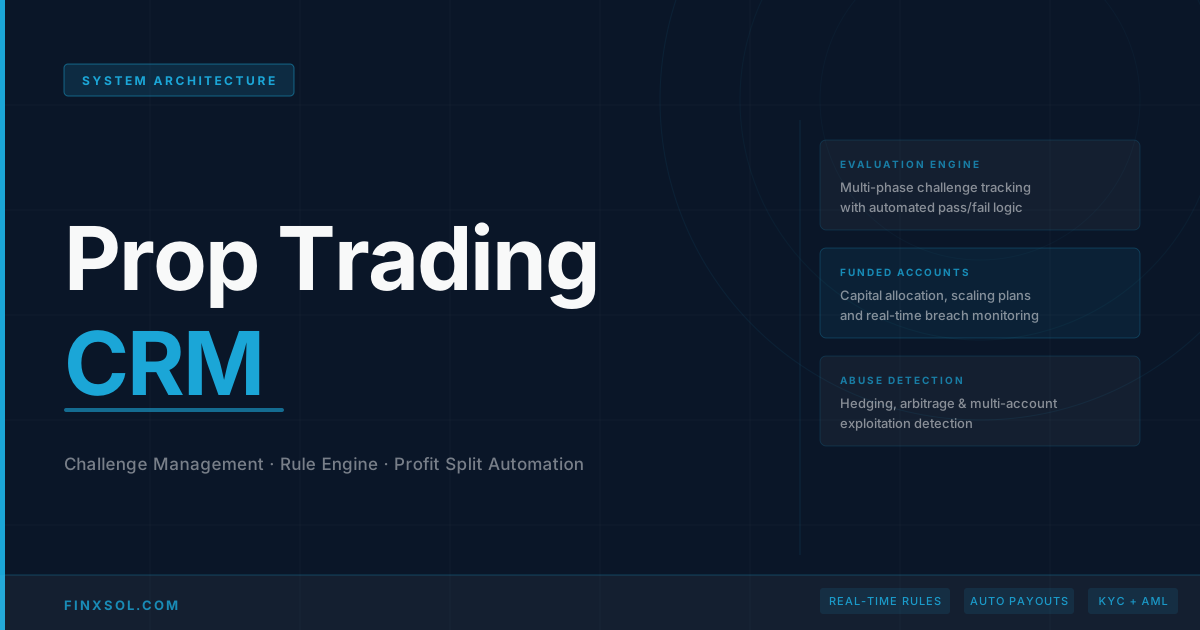
A proprietary trading firm works differently than a standard broker. You do not handle client money. You sell trading challenges, check trader discipline, and then give capital to those who pass. This business model creates needs that a regular CRM cannot meet. You need a system built for this work. So what is a prop firm CRM? It is a rule-driven platform that manages the whole trader journey, from first deposit to final payout.
If you plan to start a prop trading firm, your technology choice will decide your success. Manual processes fail when you grow. Spreadsheets cannot track drawdown limits in real time. Generic CRMs do not understand funded trader programs. You need purpose-built systems.
Why a Prop Firm CRM is Different from a Brokerage CRM
Many new firm owners ask about the difference between a standard broker system and a specialized prop trading CRM. The answer comes down to one thing: rule enforcement. A brokerage CRM tracks client information and manages IB commissions. A prop firm CRM actively watches every trade, checks every rule, and automatically decides who passes or fails.
This difference matters for compliance monitoring and risk management. When you run a proprietary trading firm, you cannot manually check drawdown limits for hundreds of traders. The system must do it for you. That is why the brokerage CRM vs prop CRM comparison is not close. One is a record keeper. The other is an automated referee.
| Feature | Brokerage CRM | Prop Firm CRM |
|---|---|---|
| Rule engine | Not present | Core requirement |
| Real-time trade monitoring | Optional | Mandatory |
| Profit split automation | Not applicable | Built-in |
| Drawdown enforcement | Manual only | Automatic |
| Abuse detection | Basic | Advanced |
CRM
Core Functions of a Prop Trading CRM
A complete prop trading CRM handles the full trader lifecycle. It starts with trader onboarding and KYC verification, then moves through evaluation phases, and finally manages payouts and scaling. Below are the main modules you should expect.
Challenge management
Create multi-phase challenges with specific profit targets, daily drawdown limits, and time-based restrictions. The system tracks each trader’s progress automatically.
Real-time performance tracking
Watch profit and loss, drawdown usage, and risk exposure second by second. Traders see their numbers on their dashboard. You see everything from the admin panel.
Rule engine
A rule engine you can configure applies your trading conditions to every account. Violation detection happens instantly. Accounts freeze automatically when rules break.
Profit split automation
Calculate and send payouts based on your split model like 70/30 or 80/20. The system checks for active violations before releasing any money.
Abuse detection
Find hedging across accounts, latency arbitrage, news exploitation, and multi-account gaming. Device fingerprinting and cross-IP monitoring catch bad actors.
Trader dashboard
Give traders a clear view of their challenge status, performance numbers, and payout history. A good trader dashboard cuts support tickets by 60% or more.
How Challenge Management Works in a Prop Firm CRM
Challenge management is the heart of any proprietary trading firm. Most firms run a two-phase or three-phase evaluation. Phase one has a profit target (usually 8-10%) with a maximum drawdown limit (5-10%). Phase two lowers the profit target but keeps similar risk rules. Traders who pass both phases receive a funded account.
A prop firm CRM automates this whole process. When a trader buys a challenge, the system creates the account, applies the correct rules, and starts tracking. Evaluation phase progression happens automatically when profit targets are met. Failed accounts turn off right away. No manual work needed.
Profit target enforcement must be exact. The CRM calculates net profit correctly, including floating versus closed positions. Drawdown limits come in two types: static (fixed maximum loss) and trailing drawdown (moving based on highest equity). A trailing drawdown moves up as the trader makes profit but never goes down. This is a common rule in modern prop firms, and your CRM must handle it correctly.
Other evaluation rules include minimum trading days (to stop one-lucky-trade passes), time-based restrictions (30-day limits or no limits), and consistency rules (no single day making most of the profit). Each of these needs automated tracking. A spreadsheet cannot do this for 1,000 active traders.
Real-Time Rule Enforcement and Risk Management
Real-time rule enforcement separates prop firms that last from those that fail. When a trader breaks a rule, the system must react right away. Not five minutes later. Not the next day. Right now.
A modern rule engine works on an event-driven setup. Every trade open, trade close, equity update, and balance change triggers a rule check. The system looks at conditions like daily loss, total drawdown, profit targets, and banned strategies. If any rule fails, the CRM can stop trading, send alerts, and log the violation for records.
Risk management in prop trading is not the same as broker risk. You are not worried about market-making exposure. You are worried about trader behavior. Does this trader hedge across multiple accounts? Are they using latency arbitrage? Are they trading news events they should not? A good prop trading CRM includes abuse detection modules for exactly these situations.
Hedging detection looks for connected trades across accounts with the same payment method or IP address. Multi-account exploitation detection finds traders who buy several challenges and offset risk to guarantee one pass. Latency arbitrage detection studies execution timing to catch price feed exploiters. These features are not extra. They protect your whole business.
For more technical details on trading systems, read our guide on brokerage technology solutions and how they apply to prop trading.
Trader Lifecycle Management from Onboarding to Payout
Trader lifecycle management covers every stage: lead capture, account purchase, challenge activation, evaluation watching, funded stage, payout processing, and scaling. A prop firm CRM connects all these stages into one automated workflow.
Trader onboarding starts with KYC verification. The CRM connects to document verification services to check IDs, proof of address, and sometimes source of funds. Once verified, the trader can buy a challenge. The CRM creates the trading account, applies the correct rule set, and sends login details.
During the evaluation, real-time trade monitoring watches every position. The trader sees their progress on their trader dashboard. You see everything from the admin panel. When the trader meets the profit target without breaking drawdown limits, the CRM automatically moves them to the next phase or to funded status.
Payout governance is another critical job. The CRM checks for active violations, minimum holding periods, and compliance clearance before sending money. Profit split automation calculates the correct amount based on your model (for example, 80% to trader, 20% to firm). Then it connects to your payment gateway to send the funds.
Capital scaling rewards traders who perform well over time. After a trader hits certain profit goals, the CRM can automatically increase their funded account size. This keeps your best traders with your firm.
To see how this fits into a complete business setup, read our step-by-step guide to starting a prop firm.
Key Features to Look for in Prop Firm Software
Real-time rule enforcement
The system must check every trade against your rules instantly. No waiting. No delays. Immediate violation detection and account freezing.
Multi-tier management
Support for affiliates, sub-traders, and complex commission structures. Many prop firms grow through partner networks.
Cloud-native platform
A cloud-native platform grows with your business. On-premise solutions create bottlenecks and limit growth.
Open APIs
Open APIs let you connect custom tools, reporting systems, and other services. Avoid closed platforms that lock you in.
Mobile accessibility
Traders expect to check their performance from their phones. Your CRM must offer a fully working mobile interface.
Audit trails and secure document storage
Every action logged. Every KYC document secured. You need this for compliance and settling disputes.
White Label Prop Firm Solutions and Turnkey Setups
Many business owners choose a white-label prop firm solution instead of building from nothing. A white label gives you a ready-made platform with your brand. You get the CRM, trader portal, rule engine, and connections without months of development.
A white-label prop trading setup typically includes back-office integration with trading platforms like cTrader, payment gateways, and KYC providers. You also get single sign-on so traders can move between your website and their dashboard without extra logins.
The trade-off is control. White labels are faster to launch but may limit changes. A fully custom build takes longer but gives you complete freedom. Most successful prop firms start with a white label and then add custom features over time using open APIs.
For a full comparison of delivery models, read about turnkey solutions for trading firms and how they apply to prop trading.
Integration with Trading Platforms and Payment Systems
A prop firm CRM does not work alone. It needs deep connections with your trading platform, payment gateways, and KYC providers. cTrader integration is a popular choice because cTrader offers modern APIs and real-time data feeds. Other platforms like MetaTrader 4 and 5 are also supported by most CRMs.
Single sign-on (SSO) is a must-have feature. Traders should sign up, deposit, and start trading without separate logins for each system. SSO improves conversion rates and cuts support tickets.
Payment processing is another critical connection. Prop firms collect challenge fees and then pay out profit splits. Your CRM must connect to multiple payment gateways, handle different currencies, and include fraud detection for suspicious transactions. Automated commission tracking is also important if you run an affiliate program.
For a closer look at platform options, see our comparison of MetaTrader alternatives for prop firms.
Common Operational Challenges Solved by a Prop CRM
Without a specialized system, prop firms face several problems. Less manual work is the biggest benefit. Processing challenge results by hand takes hours each day. A CRM does it in seconds.
Trader retention improves when traders have clear visibility into their performance. A good trader dashboard shows exactly where they stand. No confusion. No arguments. Just data.
Compliance reporting becomes easier. The CRM logs every action, every rule check, and every payout. When regulators ask questions (and eventually they will), you have answers.
Behavioral analytics help you see patterns. Which challenge types attract the best traders? Where do most failures happen? Decisions based on data beat guesses every time.
Learn more about the business side of prop trading in our article on how prop trading works from an operator’s view.
How to Start a Prop Firm with the Right CRM
If you are asking “how to start a prop firm”, your first choice should be your technology stack. Do not pick a CRM at the end. Pick it at the start. Every other choice depends on it.
Start by writing down your evaluation model. Will you offer one-phase challenges? Two-phase? Three-phase? What are your drawdown limits? Profit targets? Minimum trading days? These rules decide what your CRM must support.
Next, pick your trading platform. Multi-asset prop trading is becoming more common. Firms that offer forex, futures, and crypto from one platform attract more traders. Make sure your CRM supports all the asset types you plan to offer.
Then look at CRM providers. Ask for demos. Test their rule engine with your actual rules. Check their abuse detection. Verify their payout automation. And ask about their plans for gamification in prop trading and other features to keep traders engaged.
Finally, plan your connections. Connect the CRM to your website, payment gateways, KYC provider, and trading platform. Test everything with a small group of traders before your public launch.
For a complete roadmap, read our detailed guide to launching a prop trading firm in 2025.
Automating a Prop Firm for Scale
Automating a prop firm is not optional. It is the only way to grow beyond a few hundred traders. Manual processes create errors, delays, and unhappy traders. Automation creates consistency, speed, and trust.
Start with onboarding. Automate KYC checks, account creation, and welcome emails. Then automate challenge watching. Let the rule engine handle pass and fail decisions. Then automate payouts. The system should check rules, calculate splits, and send money without a person reviewing each one.
The goal is to run your prop firm with a small operations team. Every task that can be automated should be automated. Your team should focus on strategy, trader support, and business growth. Not manual rule checks.
A hybrid model prop trading approach can also help. Some firms mix automated evaluation with manual review for unusual cases. This gives you speed for most traders and human judgment for special situations.
For more on operating models, see our breakdown of A-book and B-book models and how they relate to prop trading.
Frequently Asked Questions
What is the difference between a prop trading CRM and a regular CRM?
How does a prop firm CRM handle drawdown limits?
Can I use a forex broker CRM for my prop firm?
How much does a prop trading CRM cost?
What is trailing drawdown and why does my CRM need to support it?
How long does it take to set up a prop firm CRM?
Conclusion
A prop trading CRM is the operational backbone of any serious proprietary trading firm. It manages trader onboarding, enforces evaluation rules in real time, automates profit splits, and detects abuse before it hurts your business. Without one, you cannot grow beyond a small group of traders. With the right system, you can manage thousands of participants, cut manual work, and focus on growing your firm.
Pick a CRM with a strong rule engine, real-time monitoring, and open APIs. Test it thoroughly before launch. And remember: the best CRM is the one that fits your specific evaluation model. What works for a forex prop firm may not work for a futures prop firm. Define your rules first. Then find the technology that enforces them automatically.
If you are ready to build or grow your proprietary trading firm, explore our prop trading solutions or contact our team for a conversation.