
Introducing Broker vs White Label: Which Forex Partnership Model Fits Your Business?
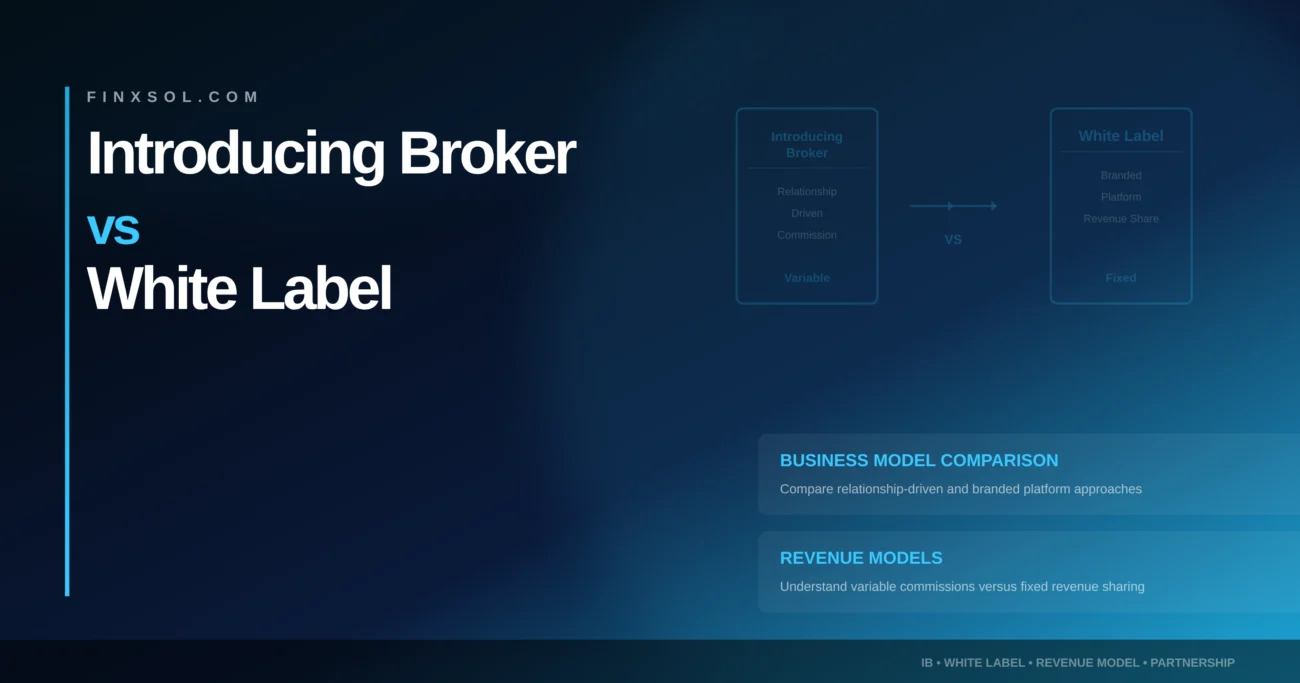
Executive summary: Choosing between an Introducing Broker vs White Label partnership changes your revenue, control, and startup costs. IBs refer clients and earn commissions with zero setup fees. White Labels run their own branded brokerage using someone else’s technology. This guide covers the difference between white label and introducing broker, costs, commission models, and how to start a Forex business the right way.
If you need a turnkey solution, explore Finxsol’s turnkey brokerage packages to launch faster.
What is an Introducing Broker? (Forex IB)
An Introducing Broker (IB) is a person or firm that brings new clients to a primary broker. You do not hold client funds. You do not process trades. You refer traders and earn a commission on their activity. The role of an introducing broker is mostly sales and marketing.
How does IB partnership work?
You sign up for a Forex partnership program. The broker gives you a referral link or a code. Every client who registers through your link is tagged to you. You earn a share of the spreads or a fixed fee per lot traded. Payments are usually monthly.
IB vs affiliate difference
An affiliate usually gets paid per lead (CPA) or a percentage of deposits. An IB gets paid on trading volume over a longer period. IBs often build ongoing relationships with traders. Affiliates focus on one-time acquisitions.
Software required for Introducing Brokers
You do not need complex software. A basic CRM or a spreadsheet works. Most brokers provide an IB portal where you see your clients, commissions, and reports. Some advanced IBs use marketing tools and SEO optimization to attract traders. Read our Forex Broker Marketing Guide for more ideas.
IB remuneration systems / reward models
- Fixed return per client: You get a flat fee per lot (e.g., $8 per standard lot).
- Revenue sharing / spread sharing percentage: You earn a percentage of the spread the broker collects. Typical rates: 20% to 50%.
- Commission from trades / transaction volume: Based on notional volume. Common for high-volume IBs.
Many IBs combine these models. The best model depends on your client type. Scalpers prefer fixed per lot. Long-term traders work better with spread sharing.
For a deeper look at broker compensation, check our article on Forex brokerage fees explained.
What is a White Label? (Forex White Label)
A White Label (WL) is a ready-made brokerage solution. You take an existing trading platform, liquidity, and back-office from a technology provider. Then you rebrand everything under your own name. Clients see your logo, your domain, and your trading conditions. The main idea of White Labeling is to launch a brokerage without building technology from scratch.
White Label components
- Trading Platform: MT4, MT5, cTrader, or Match-Trader under your brand.
- Trader’s Room: A secure portal for deposits, withdrawals, and account management.
- Investment Platform: Tools for copy trading, MAM, or PAMM accounts.
Looking for an MT5 white label? Finxsol provides MT5 white label solutions with full customization.
What does a White Label do?
A White Label operates a brokerage firm. It handles client onboarding, deposits and withdrawals, customer support, and trade execution (with the help of a liquidity provider). Some WLs have their own dealing department to manage risk. Others outsource everything.
White Label types: Limited WL vs Full WL
- Limited WL: You brand the trading platform. The provider manages risk, IT infrastructure, and client support. Lower monthly fees but less control.
- Full WL: You get your own back-office, dealing desk, and support team. You control trading conditions, margin rules, and even create sub-IBs. Higher investment but more independence.
Learn more about full white label forex broker setups on our website.
Self-branded brokerage / stand-alone brand
With a White Label, you build a stand-alone brand. Traders see you as the broker. You can set your own spreads, commissions, and bonuses. You can also create a copy trading platform for your clients. This builds long-term equity.
White Label vs Introducing Broker: Side by Side Comparison
The difference between white label and introducing broker comes down to ownership, cost, and responsibility. See the table below.
If you need help with offshore company formation for your White Label, Finxsol partners with multiple jurisdictions.
Advantages of IBs vs Advantages of White Label
Why choose an IB?
- Zero upfront investment
- No legal or compliance burden
- Work with multiple prime brokers
- Focus only on lead generation
- No customer support or back-office work
- Ideal for marketers, YouTubers, signal providers
Explore our Forex partnership program to become an IB today.
Why choose a White Label?
- Build your own brokerage firm
- Higher profit per client (keep full spread)
- Own client database – no sharing
- Set your own trading conditions
- Offer copy trading and MAM accounts
- Sell your business later as a going concern
See white label prop trading setups for new business models.
How to choose: Introducing Broker or White Label?
Use this checklist to decide which partnership fits your goals and resources.
What is your budget?
If you have less than $5,000, start as an IB. If you have $40,000+ and want a real brokerage, go White Label.
Do you want a brand or just commissions?
IBs do not own the client relationship. White Labels build a self-branded brokerage. Decide what matters more.
Can you handle back-office and support?
White Label requires dealing with deposits, withdrawals, KYC, and customer questions. IBs just refer and earn.
Do you need a legal entity?
White Label requires a company. Many choose an offshore company for flexibility. Offshore company registration is straightforward with Finxsol.
What is your long-term vision?
IB is great for quick cash flow. White Label is a business asset you can scale and sell.
Real Costs and Revenue Models: IB vs WL
Introducing Broker earnings
Most IBs earn between $5 and $15 per standard lot traded. Revenue sharing can pay 20-50% of the spread. On a 1.0 pip spread on EURUSD, a 50% share gives you $5 per lot. If your clients trade 500 lots a month, you earn $2,500. Top IBs with large networks earn $10k to $50k monthly.
White Label costs and revenue
White Label costs include: initial investment ($15k-$50k), monthly WL license ($1.5k-$5k), brokerage CRM software ($500-$2k), liquidity fee ($500-$3k), and payment gateway fees. You keep 100% of the spread. For example, if your WL charges 1.5 pips on EURUSD and clients trade 1,000 lots, your gross revenue is $15,000. After paying WL fees ($6k), you keep $9,000.
You also need a liquidity provider to execute trades and manage risk. Finxsol offers aggregated liquidity from top tier-1 banks.
Turnkey business for brokers
A turnkey solution bundles everything: trading platform, CRM, liquidity, payment gateways, and even legal setup. This is the fastest way to launch a White Label. Explore Finxsol’s turnkey solutions for a fixed price and timeline.
Adding Copy Trading and MAM/PAMM to Your Model
Both IBs and White Labels can offer more value with copy trading. White Labels can integrate a copy trading platform directly. IBs can recommend a broker that offers social trading.
For White Labels, offering MAM and PAMM accounts attracts professional money managers. These features increase client retention and trading volume. Finxsol’s MAM/PAMM solutions work with MT4 and MT5.
Also, consider supporting crypto CFDs and indices to diversify your product set. Most modern WL packages include 100+ instruments.
Frequently Asked Questions
Introducing Brokers vs White Label: Which option is the best one?
There is no single “best”. If you want low risk and quick income, IB wins. If you want to build a real brokerage firm with your own brand, White Label wins. Many successful brokers started as IBs and later upgraded to a White Label. When comparing Introducing Broker vs White Label, the decision depends on your budget and long‑term goals.
What is the difference between a white label and an introducing broker?
An Introducing Broker refers clients to a prime broker and earns commissions. A White Label runs its own branded brokerage using the technology of a provider. WL requires setup costs and a legal entity. IB requires only a referral agreement. That’s the core difference between white label and introducing broker.
How to become a Forex IB?
Find a broker with a Forex partnership program. Register as an IB. Get your referral link. Promote it to traders via a website, social media, or local network. You start earning when your clients trade. No license or company needed.
Can an IB work with multiple prime brokers?
Yes, most IBs work with 2-5 brokers. This allows you to compare spreads and offer options to your clients. Some brokers require exclusivity, so read the contract carefully. Finxsol’s white label and IB programs are non-exclusive.
What are the types of White Label?
Two main types: Limited WL (you brand the trading platform, provider runs back-office) and Full WL (your own dealing desk, customer support, and back-office). Also, Grey Label is a sub-brand under another WL, but that’s less common.
What are the advantages of White Label over IB?
White Label gives you full ownership of clients, higher revenue per trade (you keep all spreads), and the ability to set your own rules. You can also sell the business later. The disadvantage is higher startup cost and operational work. This makes White Label vs Introducing Broker a trade‑off between control and simplicity.
Conclusion
The difference between white label and introducing broker comes down to control versus simplicity. An Introducing Broker is the fastest way to monetize a trader audience. Zero cost, zero legal work, and you can start earning in days. But you do not own the brand or the client relationship.
A White Label turns you into a real brokerage firm. You get a self-branded trading platform, your own Trader’s Room, and direct access to liquidity. The upfront investment is higher, but so is the long-term reward. You build an asset.
If you are just starting and have limited capital, become a Forex IB first. Learn the market. Build a client base. Then upgrade to a White Label when you are ready. Many of our partners at Finxsol followed that path.
Ready to start your trading journey? Join our Forex partnership program as an IB or request a demo of our White Label solutions. Book a free consultation with our team to compare exact numbers for your case.