
MT4 vs MT5 White Label: Which Platform Wins for Brokers in 2026?
Planning to become a forex broker? Read this first.
What is White Label MetaTrader? (And Why Brokers Use It)
A White Label MT4 or MT5 solution is a ready-made trading platform you rebrand as your own. You don’t build software. You rent it from a licensed provider like Finxsol. Your clients see your logo, your domain, and your settings. Behind the scenes, the provider handles servers, updates, and MetaQuotes licensing.
This is the standard path for new brokers. A full MetaTrader 4 license or MetaTrader 5 full license costs $10,000+ upfront and requires dedicated IT staff. White label removes that burden. You focus on marketing and client acquisition. The technology runs itself. The best white label solution for brokers combines platform, CRM, liquidity, and payments in one package.
For a deeper technical breakdown, see our white label MetaTrader guide.
Head-to-Head: White Label MT4 vs MT5 Features
White Label MT4
- 30 built-in technical indicators (RSI, Stochastics, Bollinger Bands)
- 9 timeframes
- MQL4 programming (simpler, huge existing library)
- 4 pending order types (buy stop, sell limit)
- Single-thread strategy tester
- Forex and CFDs only (no stocks or futures)
- Best for: Pure forex brokers, Introducing Brokers (IBs)
- MetaQuotes stopped selling new MT4 WL licenses in 2022
White Label MT5
- 38 technical indicators + 46 graphical objects (Fibonacci, Elliot waves)
- 21 timeframes
- MQL5 (multi-thread, object-oriented, supports MQL5 chat feature)
- 6 pending order types (includes buy stop limit)
- Multi-thread strategy tester + real ticks backtesting
- Multi-asset: Forex, stocks, futures, options, crypto CFDs
- Built-in economic calendar and copy trading infrastructure
- Available for new white label licenses as of 2026
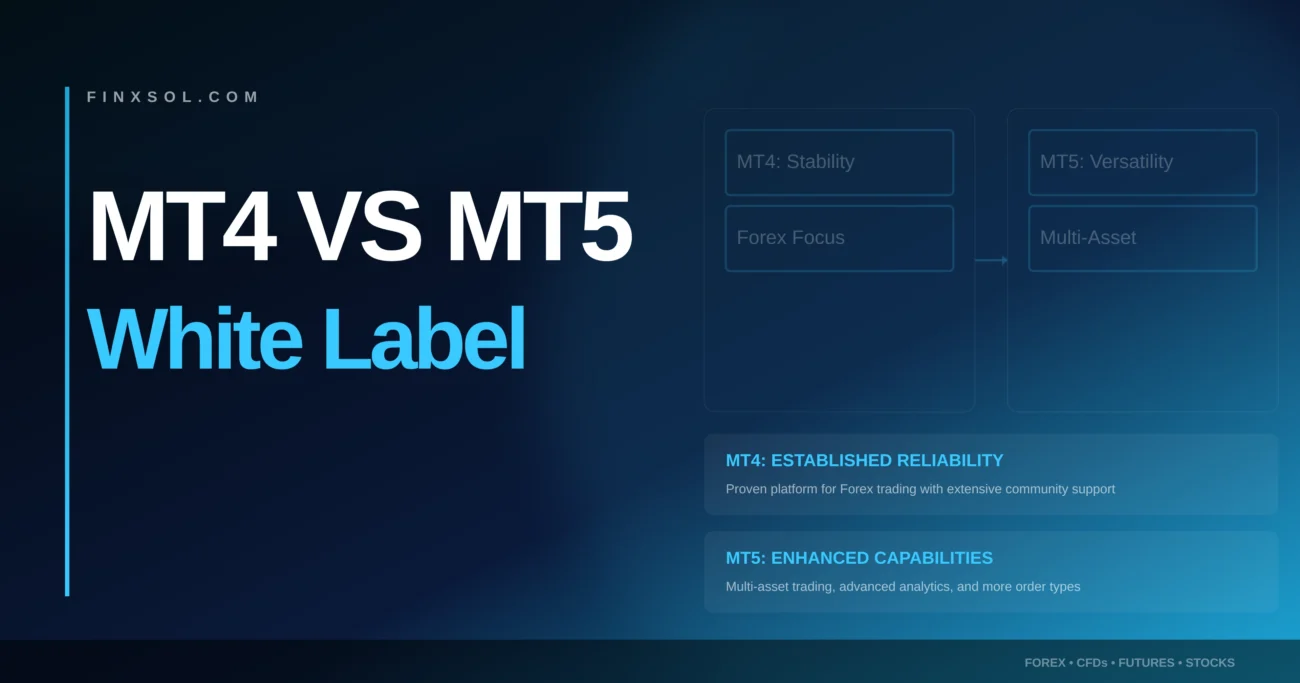
Which should you choose MT4 or MT5? If you only offer forex and CFDs and have existing MT4 traders, MT4 works. If you want stocks, futures, or cryptocurrency exchange development, MT5 is the smarter bet. The major difference between MT4 and MT5 is asset class support and backtesting capability.
White Label vs Full License: Cost Reality Check
Note on accuracy: MetaQuotes stopped selling new MT4 white label licenses to new partners in 2022. Existing providers like Finxsol who hold grandfathered MT4 main label licenses can still offer White Label MT4. MT5 white label licenses remain available for new brokers. The MetaTrader 4 full license is no longer sold to new applicants. MT5 full license monthly fee starts at $2,000 for the base license plus hosting.
Read more on MT5 white label cost in 2026 for exact pricing.
Why MQL4 vs MQL5 Programming Matters for Your Business
Your traders will want custom indicators and automated strategies. MQL4 is easier to learn and has a massive library of existing forex EAs (Expert Advisors). MQL5 is more powerful, supports multi-currency backtesting, and handles non-forex instruments. There is no compatibility between MT4 and MT5 – an EA written for MT4 will not run on MT5.
If you target retail forex traders, MQL4 keeps them happy. If you want institutional traders or multi-asset portfolios, MQL5 is non-negotiable. Many brokers run both platforms side by side: MT4 for forex, MT5 for indices and crypto. This gives you cross-device trading support across both ecosystems.
For a MetaTrader alternatives 2026 comparison, see our guide.
Liquidity Provider & Brokerage Software Integration
Both White Label MT4 and MT5 work with any major liquidity provider. You get a bridge that connects your platform to interbank liquidity. The difference is asset coverage. MT4 bridges handle forex and metals well. MT5 bridges support stocks, futures, and crypto CFDs via multi-asset liquidity providers.
Your brokerage software stack includes:
- Forex CRM provider – client onboarding, KYC verification automation, IB and affiliate management
- Trader’s room software – deposits, withdrawals, account statements
- Back office automation – multi-tier commission structure, rebates, risk monitoring
- Payment processing integration – crypto payment processing, fiat gateways, deposit and withdrawal friction reduction
- Real-time trading account provisioning – instant account creation after KYC
All these integrate with both MT4 and MT5. The key is choosing a provider that offers complete account control for brokers and compatibility with any liquidity source. Finxsol builds these integrations into every white label. A generic CRM vs brokerage CRM is a major difference – you need one built for MT4/MT5 specifically.
Check our forex CRM solution page for specific features like multi-tier commission and real-time provisioning.
How to Start a Forex Brokerage with White Label MT4/MT5: 7 Steps
For a complete walkthrough, see our forex broker setup guide and how to start a forex brokerage firm.
MT4 Limitations vs MT5 Features: The Real Differences
MT4 was built in 2005. It’s stable but old. MT5 fixed many structural issues but traders resisted change. Here’s what actually matters for a broker:
- Order types: MT5 adds Buy Stop Limit and Sell Stop Limit. Useful for professional traders. MT4 has 4 pending orders, MT5 has 6.
- Execution: MT5 supports Fill or Kill, Immediate or Cancel. MT4 only has instant and market execution.
- Backtesting: MT5 multi-thread strategy tester with real ticks is 10x faster than MT4 single-thread. Essential for multi-currency backtesting.
- Economic calendar: Built into MT5. MT4 requires plugins.
- Copy trading: MT5 has native MQL5 copy trading platform. MT4 relies on third-party PAMM/MAM solutions.
- Market coverage: MT4 is for Forex and CFDs only. MT5 supports stocks, futures, options, commodities, and crypto CFDs.
If you offer prop firm challenge management, drawdown rule enforcement, funded account management, or performance-based payouts, MT5’s risk and backtesting tools are superior. See our prop firm solution provider page for details.
Which Should You Choose: MT4 or MT5 for Your Brokerage Model?
Choose White Label MT4 If:
- You focus only on forex and metals (CFDs)
- Your target traders are retail (experienced with MT4 ease of use)
- You want the lowest learning curve for support staff
- You need access to 10,000+ existing MQL4 EAs and custom indicators
- You are an Introducing Broker (IB) looking for MT4 White Label for Introducing Brokers
- Your provider has a grandfathered MT4 main label license
Choose White Label MT5 If:
- You plan to offer stocks, indices, futures, options, or crypto CFDs
- You want a built-in copy trading infrastructure and economic calendar
- You are building a prop trading firm (funded accounts, challenge management)
- You need advanced charting capabilities (Fibonacci, Elliot waves, 21 timeframes)
- You require multi-currency backtesting and real-tick strategy testing
- You want a platform that’s future-proof for multi-asset liquidity
Still unsure? Many brokers launch with MT4 first (if available), then add MT5 after 12 months. Both platforms can run alongside each other using the same back office and CRM. This gives you cross-device trading support across both ecosystems. The question “Is MetaTrader 5 better than MetaTrader 4” depends on your asset mix. For pure forex, MT4 is still dominant. For anything else, MT5 wins.
Brokerage Operational Efficiency & Compliance Considerations
Your choice of platform affects back-office workload. MT5 has better built-in audit logging and role-based access control. Both platforms require data residency considerations for regulated brokers. CySEC, FCA, and FSCA all require client communication audit trails and transaction monitoring.
A fragmented tech stack (separate CRM, bridge, and platform) causes manual reconciliation issues and onboarding abandonment rates. The best white label solution for brokers integrates everything: CRM, trading platform, liquidity bridge, and payments in one stack. This reduces client churn and improves brokerage operational efficiency.
For regulatory compliance, you’ll need AML transaction monitoring, PEP and sanctions screening, and regular audit logging. Finxsol provides these as part of our forex broker turnkey solutions.
Frequently Asked Questions
What is the main difference between MT4 and MT5 for a broker?
The main difference between MT4 and MT5 is asset support. MT4 supports only forex and CFDs. MT5 supports stocks, futures, options, and crypto. MT5 has 38 indicators vs MT4’s 30, 21 timeframes vs 9, and a multi-thread strategy tester. MT5 also includes an economic calendar and built-in copy trading. MT4 is easier for retail forex traders to learn but MetaQuotes stopped selling new MT4 white label licenses in 2022.
Can I offer both MT4 and MT5 white label to my clients?
Yes. Many brokers offer both platforms. Your clients can choose which terminal to use. You need separate white label agreements for each platform. The same CRM, liquidity bridge, and back office can serve both. Finxsol provides dual-platform setups. Note that MT4 availability depends on your provider having a grandfathered license.
Is MetaTrader 5 better than MetaTrader 4 for low-cost forex market entry?
For pure low-cost forex entry, MT4 has been the standard. But since MetaQuotes stopped selling new MT4 white label licenses, MT5 is now the only option for most new brokers. MT5 white label costs are similar to MT4’s historical pricing. The bigger factor is your target assets. If you only need forex, MT5 works fine. For multi-asset, MT5 is the only choice.
What is a white label in forex and how is it different from a full license?
A white label in forex means you rent the platform from a provider who holds the main MetaQuotes license. You get branding and settings control but not server access. A full license (main label) gives you your own server, full admin rights, and the ability to create sub-white labels. White label is faster and cheaper to start (2-4 weeks vs 2-6 months). Full license is for large brokers with IT teams. The MetaTrader 4 full license is no longer sold to new applicants.
Read our detailed what is white label in forex article.
Does MT5 work with any liquidity provider?
Yes. MT5 connects to any FIX API liquidity provider via a bridge or gateway. The bridge translates MT5 protocol to standard FIX. Most providers support MT5 for forex, metals, indices, and crypto CFDs. For futures and stocks, confirm your LP supports those asset classes on MT5. The platform is compatible with any liquidity source when properly bridged.
How much does a branded trading platform cost for a startup broker?
A branded MT5 white label costs $5,000-15,000 one-time plus $1,500-5,000 monthly. Add a forex CRM ($500-2,000/mo), liquidity bridge ($500-2,000/mo), and KYC tools ($200-1,000/mo). First-year total: $40,000-120,000. This includes complete account control for brokers, cross-device trading support, and compatibility with any liquidity source. MT4 white label (if available through grandfathered providers) has similar pricing.
Get a custom quote from Finxsol white label broker packages.
What happened to MT4 white label licenses? Can I still get one?
MetaQuotes stopped selling new MT4 white label licenses to new partners in 2022. However, existing technology providers who already hold MT4 main label licenses can still offer MT4 white label to brokers. These grandfathered providers have limited capacity. If you want MT4, you must work with an authorized provider like Finxsol that already has the license. New brokers cannot buy a MetaTrader 4 full license directly from MetaQuotes anymore.
Conclusion: Your Next Step in the MT4 vs MT5 Decision
The MT4 vs MT5 debate now has a practical answer. MT4 is still available through grandfathered providers and remains excellent for pure forex brokers. But for most new startups, MT5 is the only realistic path forward. It offers multi-asset liquidity support, better backtesting, and built-in copy trading.
Don’t overthink the technical differences. Both platforms are stable, both integrate with prime brokerage technology, and both support IB modules and back-office automation. The real question is what your traders will trade next year. If the answer includes stocks, crypto, or futures, choose MT5.
At Finxsol, we deploy both MT4 (via grandfathered license) and MT5 white labels with full CRM, liquidity, and payment processing. We also handle top jurisdictions to start a forex brokerage including CySEC, FCA, FSCA, Comoros, Mauritius, and Seychelles. Company creation for brokers, bank accounts, and regulatory compliance are part of our turnkey service. You get a branded trading platform in 2-4 weeks, not 6 months.
Ready to launch? Start with a free consultation or browse our white label solutions.