
Forex Broker Software and Infrastructure: What You Actually Need
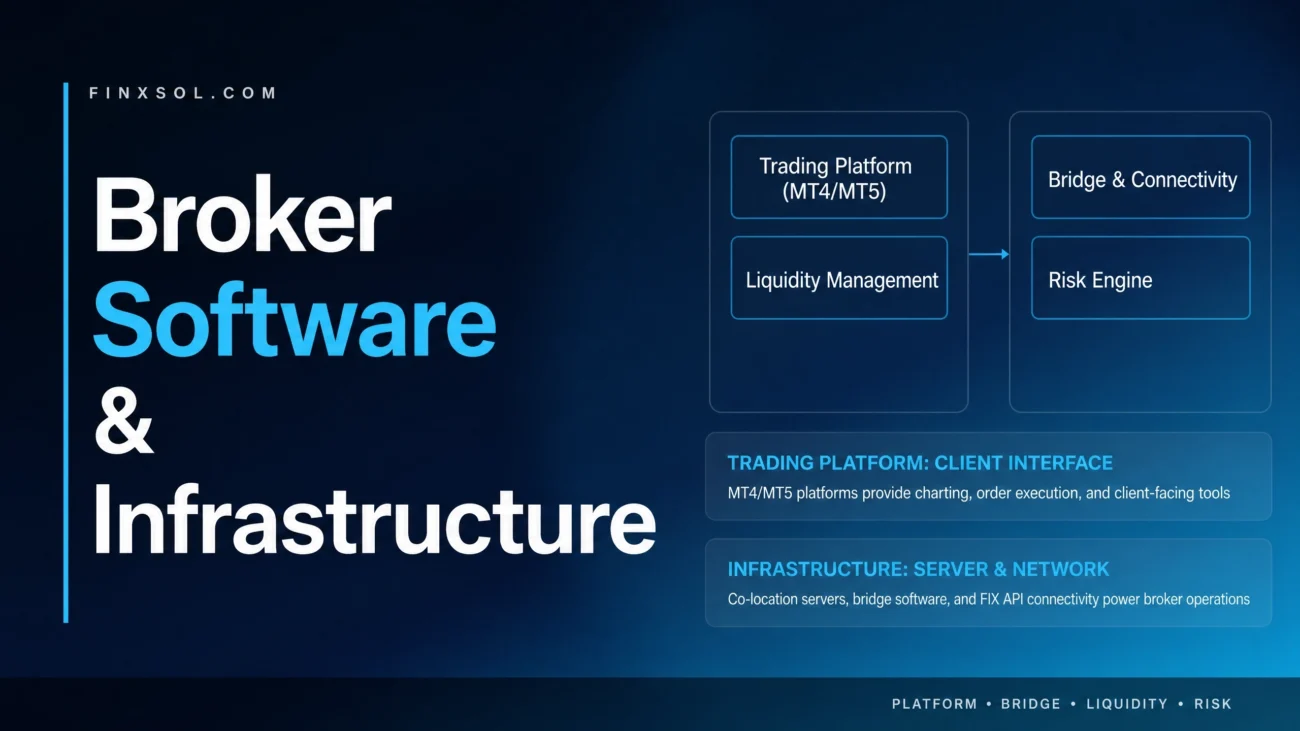
Executive Summary: Starting a forex brokerage means making smart technology decisions early. The software and infrastructure you pick will determine your trade execution speed, your ability to manage risk, and how smoothly you handle client accounts. This guide walks through every major component: the trading platform for forex brokers, the forex risk management system, the forex back-office system, liquidity connections, and compliance tools. No theory. Just what works in practice.
If you are mapping out your full setup, explore our forex broker turnkey solutions for a ready-to-launch package.
The Five Core Components of Forex Brokerage Infrastructure
Every forex brokerage business runs on five linked software systems. Skip one, and something breaks. Here they are, in order of importance.
Trading Platform
The client-facing interface where traders place orders, view real-time forex quotes, and apply technical indicators for forex. This is your storefront. MetaTrader 4, MetaTrader 5, and cTrader dominate the market. Each supports order types in forex like limit orders, stop-loss orders, and trailing stop orders.
Forex CRM & Back-Office System
The forex back-office system handles forex account management, client onboarding and identity verification, deposits, withdrawals, affiliate tracking, and reporting. A proper forex CRM connects every department to a single client record. Without it, operations become a manual mess.
Risk Management System
A forex risk management system monitors exposure in real time. It enforces A/B book settings, execution rules, and margin settings. Good systems include trade monitoring tools that flag unusual patterns and automated margin alerts. This is what keeps a brokerage solvent during volatile markets.
Liquidity Connections
A liquidity provider for forex supplies the prices your clients trade on. You connect through a liquidity bridge or FIX API. The quality of your liquidity determines your spreads, your forex trade execution speed, and whether clients get slipped on orders.
Compliance Software
Forex compliance software covers AML and KYC for forex brokers, sanctions screening, transaction monitoring, and regulatory reporting. Most regulators require automated identity checks before any account goes live. Built-in compliance reporting saves hours of manual work each month.
Payment Processing
Clients need to deposit and withdraw funds. Payment gateway integration connects your platform to card processors, bank transfers, and crypto rails. Speed matters. Slow deposits kill conversion rates. Forex payment solutions should support multiple methods and currencies.
Trading Platform for Forex Brokers: Your Client’s Front Door
The trading platform is the single largest factor in client satisfaction. Traders judge your entire brokerage by how fast orders fill, how stable the platform runs, and whether the interface makes sense. Choose wrong here, and even the best back-end cannot save you.
MetaTrader 4 (MT4) for Startups
MT4 remains the most widely used platform in retail forex. It has the largest ecosystem of third-party trading platform integration, plugins, and expert advisors. For a startup forex broker, MT4 offers instant brand recognition. Traders know it. They trust it. The learning curve is zero. Most white-label forex broker software packages include MT4 as the default option.
MetaTrader 5 (MT5) for Startups
MT5 is the multi-asset successor to MT4. It supports forex, stocks, futures, and crypto CFDs from a single account. The depth of market is better. Backtesting is faster. If you plan to offer more than just forex, MT5 is the smarter long-term pick. Check our breakdown of top MT5 white label features for a detailed comparison.
cTrader for Brokers
cTrader has gained ground with traders who want a cleaner interface and more order type control. It supports advanced order types in forex including market, limit, stop, and trailing stop orders with more granular settings. Launching a white-label cTrader forex broker gives you a platform that appeals to experienced traders who find MT4 dated.
Platform Comparison: MT4 vs MT5 vs cTrader
All three platforms are solid. The right choice depends on your target clients and asset coverage plans.
For a broader look at available options, see our roundup of top forex trading platforms with detailed feature comparisons.
The Forex Back-Office System: Where the Real Work Happens
Clients see the trading platform. You see the back office. This is where forex account management, KYC approvals, deposit processing, affiliate payouts, and reporting live. A weak back office creates friction everywhere.
What a Forex CRM Does for Your Brokerage
A forex CRM is more than a client database. It connects trading accounts to identity records, tracks deposits and withdrawals, manages introducing broker commissions, and gives you role-based dashboards. Your support team sees ticket history. Your compliance officer sees verification status. Your finance team sees pending withdrawals. Each role gets exactly what they need.
Modern systems include lead scoring for forex brokers, campaign automation, and modular integration with payment processors and liquidity providers. When evaluating options, look at our detailed guide on forex CRM features to understand what separates basic CRMs from broker-grade systems.
A/B Book Settings and Execution Rules
Every broker needs to decide how orders flow. A-book means orders pass straight to your liquidity provider. B-book means you internalize the trade. Most brokers run a hybrid with A/B book settings that route trades based on client behavior, instrument, or size. Your A-book and B-book model choice directly affects your revenue and risk. Configure execution rules carefully. Set margin settings per group. Define which clients go A-book and which stay B-book. The software should let you change these rules without breaking anything.
Forex Risk Management System: Protecting Both Sides
Risk management is not optional. A single unhedged position during a news spike can wipe out months of profit. Your forex risk management system must catch problems before they become losses.
Real-Time Trade Monitoring Tools
Trade monitoring tools watch every position across every account. They flag unusual activity: a client suddenly trading 10x their normal size, multiple accounts placing identical trades, or patterns that suggest price manipulation. Good tools send margin alerts before accounts blow up. Automated payouts to liquidity providers keep your hedging in sync. The system should also prevent price manipulation by comparing your feed against the broader market in real time.
Margin Settings and Exposure Controls
Set margin requirements by instrument, by client group, and by time of day. Increase margins before major news events. Reduce them during quiet sessions. The software should support regulatory margin requirements from your jurisdiction while giving you room to add extra buffers. If a client’s equity drops below the margin threshold, the system must liquidate positions automatically, starting with the largest loss. No manual intervention. No delay.
Liquidity Provider for Forex: The Fuel for Trade Execution
Without liquidity, you have no prices to show clients. A liquidity provider for forex streams real-time forex quotes that your platform displays. When a client hits buy or sell, your system either fills the order internally or routes it to the liquidity provider. Execution speed matters. Every millisecond of delay increases slippage and damages client trust.
How Liquidity Connections Work
You connect to a forex liquidity provider through a FIX API or a liquidity bridge. The provider sends a continuous stream of bid and ask prices. Your platform marks them up with your spread and shows them to clients. When a trade comes in, the bridge decides whether to A-book it to the provider or B-book it internally. This decision happens in milliseconds. The quality of your bridge and your provider directly determines your forex trade execution speed.
Choosing the Right Liquidity Setup
Look for providers with deep order books in the currency pairs your clients trade most. Ask about minimum monthly volume commitments. Test their real-time forex quotes during volatile periods. A provider that widens spreads aggressively during news will hurt your clients and your reputation. Some brokers connect to multiple liquidity providers and aggregate the best prices. This requires a more advanced infrastructure but delivers tighter spreads.
Forex Compliance Software: Staying Legal Without the Headaches
Regulators expect brokers to know their clients, monitor transactions, and report suspicious activity. Forex compliance software automates most of this. It handles AML and KYC for forex brokers by verifying identity documents, checking sanctions lists, and flagging high-risk profiles before accounts go live.
Client Onboarding and Identity Verification
The onboarding flow is where most brokers lose potential clients. Too many steps, and people abandon the process. Too few, and you fail compliance. Good client onboarding and identity verification software balances speed with thoroughness. It asks for the minimum required documents, runs automated KYC/AML checks, and approves clean profiles instantly. Only edge cases need manual review. This keeps conversion rates high while keeping regulators satisfied. Read about forex broker regulations and licenses to understand what your specific jurisdiction requires.
Regulatory Reporting Built In
The best compliance tools generate reports in the format your regulator expects. Transaction reports. Suspicious activity reports. Large trade notifications. If your software cannot produce these automatically, you will spend hours each week compiling data manually. Built-in compliance reporting is not a luxury. It is a requirement for running a professional forex brokerage business.
How to Choose Your Forex Brokerage Technology Stack
Every brokerage has different needs. A startup forex broker targeting retail clients in Southeast Asia needs a different setup than an established firm serving institutional traders in Europe. Here is a practical selection framework.
Technology Stack Selection Checklist
- Define your target market first. The jurisdiction determines your licensing requirements, which determines your compliance software needs. A CySEC-regulated broker has different reporting obligations than one registered in Saint Lucia. Start with the regulation, then pick the tools.
- Pick your trading platform. MT4, MT5, or cTrader. Match the platform to your clients. If your audience uses expert advisors, MT4 is hard to beat. If you are building a multi-asset trading platform for the long term, MT5 or cTrader makes more sense. Check available trading platforms for current options.
- Select your CRM and back-office system. The CRM ties everything together. It must integrate with your platform, your payment gateways, and your compliance tools. Look for a forex CRM solution with role-based dashboards, campaign automation, and modular integration capabilities.
- Connect your liquidity. Choose a liquidity provider that covers your trading instruments with tight spreads and fast execution. Ask about their liquidity bridge setup and FIX API connectivity. Test their feed during volatile market conditions.
- Layer in risk management. Configure A/B book settings, margin rules, and automated alerts before you go live. Risk controls must be active from day one. Retrofitting them after a loss is expensive.
- Add compliance and KYC/AML automation. Integrate identity verification, sanctions screening, and transaction monitoring. Make sure your compliance software can generate reports for your regulator without manual work.
- Set up payment processing. Connect payment gateways that support your clients’ preferred methods. Test deposit and withdrawal flows end to end before launch.
- Plan for scale. Choose cloud-native infrastructure that supports high user concurrency and real-time data syncing. Ask your technology partner about system redundancy and disaster recovery. A growing broker cannot afford downtime.
White-Label vs Full Infrastructure Build: Which Path to Take
New brokers face a fundamental choice: rent infrastructure through a white-label provider or build everything from scratch. Both paths work. The right one depends on your budget, timeline, and technical resources.
Most new brokers start with a white-label forex broker package and upgrade later. It gets you to market faster with less capital at risk. For a complete step-by-step walkthrough, read our guide on how to launch your own forex broker.
Infrastructure That Keeps Your Brokerage Running
Software is one piece. The underlying infrastructure determines whether your platform stays up during peak trading hours. Three things matter most.
Cloud-Native Infrastructure for Forex
Cloud-native infrastructure for forex gives you flexibility. You scale up during volatile markets without buying physical servers. You deploy in multiple regions for lower latency. Cloud-based forex software also reduces upfront hardware costs. Most technology providers now run on AWS, Google Cloud, or Equinix data centers near major financial hubs.
System Redundancy and Disaster Recovery
If your primary server fails, clients must still trade. System redundancy and disaster recovery planning means running parallel instances in different geographic zones. If London goes down, New York takes over. Real-time data syncing ensures no trades are lost during failover. Ask your technology partner to explain their redundancy setup before you sign.
Security Standards for Trading Platforms
Trading platforms handle sensitive client data and real money. Security standards for trading platforms must include encryption at rest and in transit, DDoS protection, regular penetration testing, and strict access controls. A single breach destroys client trust permanently. Invest in security from day one.
Frequently Asked Questions
What software is needed to run a forex brokerage?
You need a trading platform (MT4, MT5, or cTrader), a forex CRM with back-office functions, a risk management system, liquidity provider connections, and compliance software for KYC/AML checks. These five components form the core forex brokerage technology stack. Many brokers also add payment gateway integration and affiliate tracking software. Explore turnkey brokerage packages that bundle these together.
How to choose the right forex brokerage software?
Match the software to your budget, target market, and growth plan. Check if the platform supports your required order types, integrates with your preferred liquidity providers, and includes built-in compliance tools. Ask about scalability, hosting location, and support response times before signing. A forex white-label program comparison can help you evaluate bundled options side by side.
What are the key features of a stable and user-friendly trading platform?
A stable trading platform needs fast trade execution speed, real-time forex quotes, a clean interface, mobile and web access, support for limit orders, stop-loss orders, and trailing stop orders, plus a full set of technical indicators for forex analysis. High user concurrency support is also critical. If 500 clients trade simultaneously during NFP, the platform must handle the load without lag.
What are the best risk management tools for forex brokers?
The best tools include A/B book settings with configurable execution rules, margin settings and margin alerts, automated payouts, trade monitoring tools to detect price manipulation, and real-time exposure dashboards. A solid forex risk management system protects both the broker and clients. Some brokers also use A-book and B-book hybrid models to balance risk and revenue automatically.
How do liquidity providers work for FX brokers?
Liquidity providers supply real-time buy and sell prices that brokers stream to their clients. The broker connects via a liquidity bridge or FIX API. When a client places a trade, the broker can route it to the liquidity provider for execution. This gives tight spreads and deep market depth. Most brokers connect to multiple providers and aggregate the best available price.
What compliance software is needed for forex regulatory reporting?
Forex compliance software handles AML and KYC checks, client onboarding and identity verification, transaction monitoring, sanctions screening, and regulatory reporting. Many modern platforms include built-in compliance reporting features that auto-generate reports for regulators. The specific tools you need depend on your jurisdiction. Check our forex broker regulations guide for jurisdiction-specific requirements.
Conclusion
Building a forex brokerage is not about finding one piece of software. It is about assembling five or six systems that work together without friction. The trading platform brings clients in. The CRM and back office keep operations running. The risk management system keeps you solvent. The liquidity connections give you competitive pricing. The compliance software keeps regulators off your back.
Most new brokers overcomplicate the technology and underinvest in integration. The smartest move is to work with a technology partner who has already connected these pieces. A forex broker turnkey solution gives you a tested stack with pre-built integrations. You focus on growing your client base while the infrastructure runs in the background.
Start with a clear picture of your target market. Pick the platform your clients already know. Connect reliable liquidity. Layer in compliance and risk controls. Test everything before you launch. The brokers who succeed are not the ones with the flashiest website. They are the ones whose software works reliably, day after day, trade after trade.
If you are ready to start building, contact our team for a custom consultation on your forex brokerage infrastructure.