
Dealing Desk vs No Dealing Desk Brokers: Which Model Is Best for Your Startup in 2026?
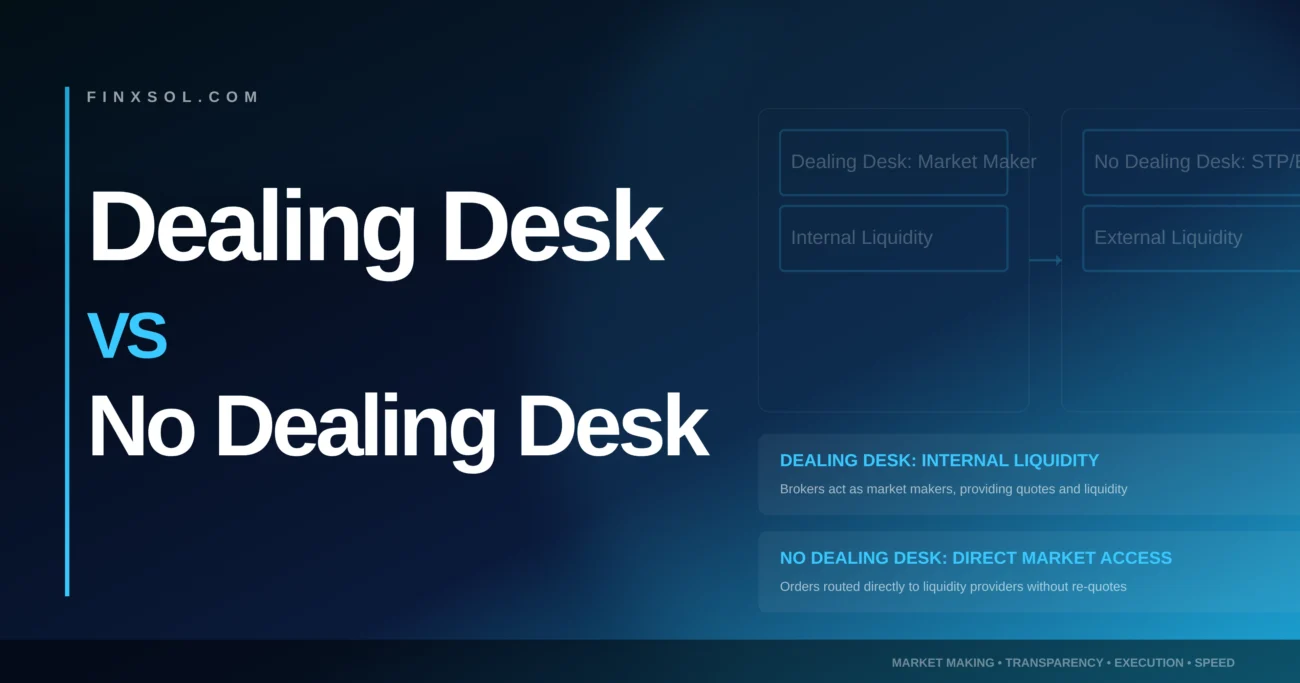
Executive summary: In 2026, launching a brokerage means choosing between a dealing desk broker (market maker) or a no dealing desk broker (STP/ECN). The first model gives you fixed spreads and internal risk but requires more capital and regulatory scrutiny. The second offers direct market access and transparency but needs solid liquidity aggregation and lower margins per trade. This guide breaks down DD vs NDD, real costs, conflict of interest, and which one actually works for a brokerage startup.
If you are planning your brokerage startup model, the decision affects everything from your revenue model to your technology stack. Let’s compare them directly.
What Is a Dealing Desk Broker? (Market Maker Model)
A dealing desk broker, often called a market maker broker, creates an internal market for clients. When you place a trade, the broker takes the opposite side. This is the “B-book” model. The broker doesn’t send your order to external liquidity providers; instead, they match buy and sell orders internally.
For a brokerage startup, this model gives you predictable revenue because you earn the spread (fixed spreads) and you can profit when clients lose. But it also creates a conflict of interest – you trade against your own clients. What is market making? It’s the core of the dealing desk approach.
Pros of Dealing Desk (DD) for startups
- Fixed spreads – attractive for beginner traders
- Lower technology costs (no complex LP bridging)
- Revenue from both spreads and client losses (if hedged smartly)
- Easier forex broker turnkey solutions integration
Cons of Dealing Desk (DD)
- Direct conflict of interest – trader trust issues
- Higher regulatory capital requirements (MiFID, FCA, ASIC)
- Risk of large losses if clients win consistently
- Limited appeal for professional or scalping traders
What Is a No Dealing Desk Broker? (NDD – STP/ECN)
A no dealing desk broker (NDD) passes client orders directly to liquidity providers. There’s no internal intervention. Two main variations exist: STP (straight-through processing) and ECN (electronic communication network). NDD brokers earn via a small commission or a markup on raw spreads. They don’t trade against clients.
For startups that want transparent trading and fast execution, the NDD broker model is ideal for experienced and high-frequency traders. However, you need robust liquidity aggregation software and a reliable bridge. Many new brokers start with white label white label brokerage startup packages that include pre-configured NDD execution.
Pros of No Dealing Desk (NDD)
- No conflict of interest – pure agency model
- Variable spreads (tight as 0.0 pips on major pairs)
- Attracts scalpers, algos, professional traders
- Transparent market pricing – better brand trust
- Easier best execution policy NDD compliance
Cons of NDD for startups
- Requires low-latency bridge and multiple liquidity providers
- Lower per-trade margin (commissions are small)
- Minimum volume commitments from LPs
- Clients may complain about variable spreads during volatility
DD vs NDD: Direct Comparison for Brokerage Owners
When to pick a Dealing Desk model
You want to offer fixed spreads and manage internal risk. Your target audience is retail beginners who prioritise cost predictability. You plan to use an A-book and B-book models hybrid to hedge selectively. Your startup capital is higher but you seek higher revenue per client.
Broker regulation requirements for market makers are stricter, but many offshore jurisdictions allow DD operations with lower thresholds.
When to pick a No Dealing Desk model
You target experienced traders who demand ultra-tight spreads and fast execution. You prefer a transparent, conflict-free brokerage. NDD requires solid liquidity providers and a good bridge. It’s the preferred model for white label startups wanting a clean brand image.
Check our brokerage technology infrastructure guide for NDD setups.
How to Choose a Brokerage Model: 6-Step Selection Checklist
Brokerage Startup Cost Structure: DD vs NDD in 2026
Startup costs differ significantly. A dealing desk broker may pay less for liquidity feeds but needs a sophisticated risk management desk and possibly higher regulatory capital. Example: an FCA-regulated market maker requires €730k+ capital. An NDD broker under the same license may require less if operating on a matched-principal basis.
For technology: DD runs on an in-house trading system with internal order matching. NDD requires low-latency bridging solution and aggregation from 5+ liquidity providers. White label packages often include both options. Many of our white label brokerage startup clients start with NDD and later add a hybrid B-book module.
Practical note: You don’t have to choose 100% DD or NDD. Many successful startups run a hybrid model: route profitable traders to A-book (NDD) and hedge, while keeping less experienced traders on B-book (DD). That’s the A-Book vs B-book brokerage strategy.
Fixed Spreads vs Variable Spreads: What Your Traders Want
Fixed spreads are the trademark of dealing desk brokers. They give beginners peace of mind – no slippage surprises. But during high volatility, the dealing desk may widen spreads or reject orders. Variable spreads (ECN/STP) reflect real interbank liquidity: as low as 0.1 pips on EURUSD during London session, plus a small commission. Professional traders prefer variable spreads because they get better pricing and direct market access.
Your choice influences your entire client acquisition: retail vs professional traders brokerage strategy. Retail beginners lean toward fixed, while day traders and algo funds demand variable spreads with ultra-low latency.
Frequently Asked Questions: Dealing Desk & NDD Brokers
A dealing desk is an internal trading desk within a market maker broker. It executes client orders internally instead of sending them to the outside market. The desk matches buy/sell orders and acts as the counterparty. This gives the broker fixed spreads but creates a potential conflict of interest. Many retail brokers operate a dealing desk alongside a risk management system.
Yes, by definition a market maker broker (dealing desk) takes the opposite side of a client’s trade. That means if you buy, they sell. That’s the B-book model. It’s legal and common, but the broker’s profit comes from your losses. That’s why transparency and best execution policies matter. On the other hand, NDD brokers never trade against you; they pass orders to liquidity providers.
NDD stands for “No Dealing Desk”. An NDD broker sends client orders directly to external liquidity providers (banks, non-bank LPs) without any internal intervention. Yes, NDD is far more transparent because there is no conflict of interest. Prices come directly from the interbank market. That’s why experienced traders trust NDD brokers more, especially for scalping broker model strategies.
Short-term, NDD can be cheaper to start if you use a white label with pre-integrated liquidity. Dealing desk requires more risk capital and a dealing team, but revenue per client is often higher. However, from a regulatory standpoint, a pure NDD broker might face lower capital requirements under some jurisdictions (e.g., offshore licenses). Check offshore forex company formation options to compare costs.
To run an NDD broker you need: a trading platform (MT4/MT5, cTrader), a liquidity bridge (OneZero, PrimeXM or similar), aggregation software, and at least two liquidity providers. You also need low-latency hosting. Many startups use a white label forex broker package that includes all NDD components pre-integrated. That cuts months of development.
Absolutely. Hybrid A-book/B-book is the standard for smart brokerages. You route low-risk or unprofitable clients to B-book (dealing desk) to keep their losses as revenue. Profitable traders or high-frequency clients go to A-book (NDD/STP) where you hedge the risk. This requires a smart broker risk management system and real-time monitoring. Most turnkey providers include hybrid features by default.
Conclusion: Which Model Wins for Your 2026 Brokerage?
There’s no absolute winner. A dealing desk broker (market maker) works best if you target beginner traders, you have enough capital to manage risk, and you operate in less restrictive jurisdictions. A no dealing desk broker (NDD) wins if you want a transparent brand, attract experienced traders, and prefer a technology-driven setup without client conflict.
Most startup brokers today launch with a hybrid model. They use NDD execution for 50-70% of volume and a managed B-book for specific segments. The key is to align your choice with your budget, forex broker setup guide timeline, and target market. Speak to technology providers who offer both dealing desk vs no dealing desk capabilities under one roof.
If you are still evaluating your brokerage startup model, explore our turnkey solutions or read the complete startup guide for 2026. Make the choice based on real numbers, not hype.